


Articles
Article
How to Make Homemade Candle Wicks
Table of Contents
How to Make Homemade Candle Wicks
What You Can Use
How to Make and Prime a Cotton Wick
How to Make a Simple Wood Wick
Homemade vs. Sized Wicks
FAQ
Browse Sized Wicks Instead
You can make homemade candle wicks at home from cotton twine or a thin wood strip. Prime it in melted wax first so it burns steady instead of drowning in its own wax pool. Sizing a wick correctly for your jar, wax, and fragrance load takes trial and error. Read more to find out how to make one properly, plus an honest read on when to skip DIY and grab a pre-tabbed wick instead. New to the craft? Our candle making guide covers wax, fragrance load, and cure time before wicks ever come up.
What You Can Use
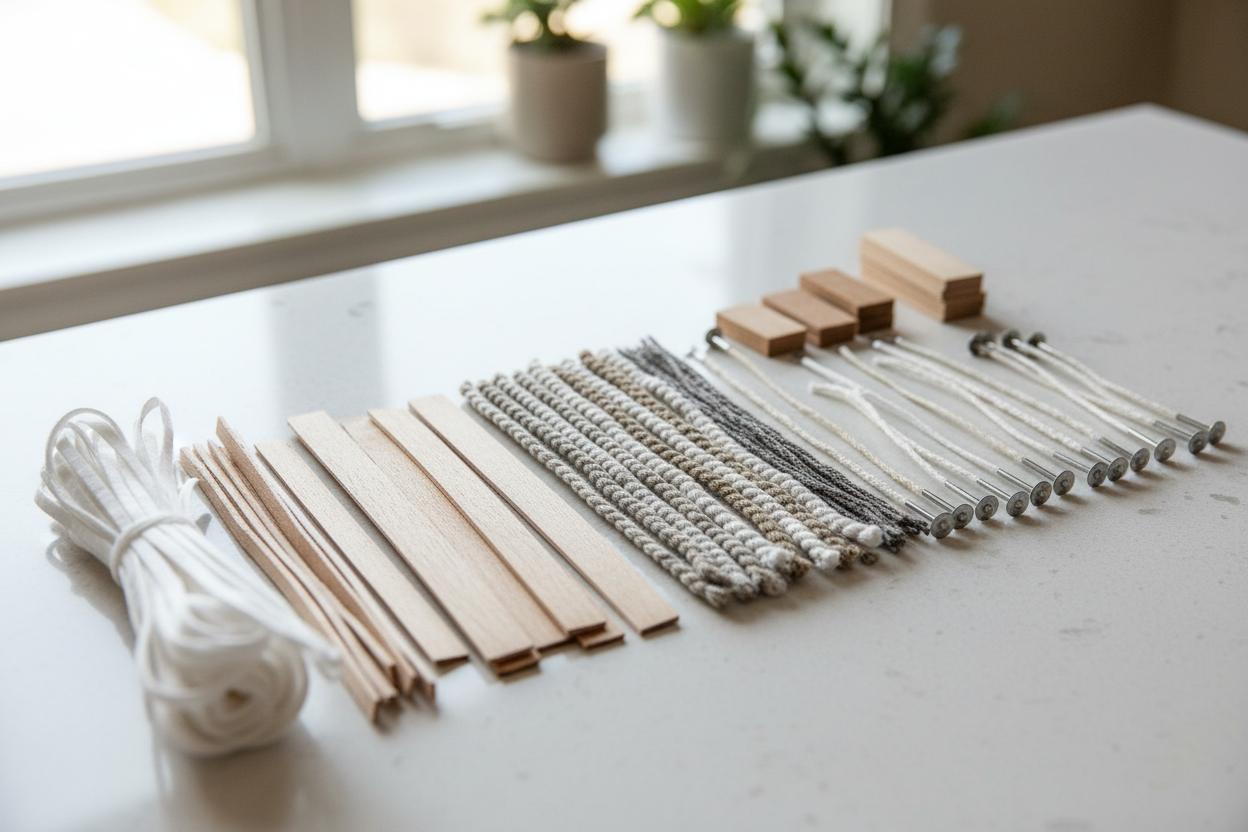
You can make a wick from cotton twine or a thin wood strip, primed in wax. For twine, reach for unbleached cotton butcher's twine. It's 100% cotton, tightly braided, and burns clean once it's been through wax. For something rigid, cut basswood or balsa into thin strips.
Skip anything synthetic, including string, dental floss, embroidery thread, poly or nylon blends. Synthetics don't burn, they melt. Plus, a bead of molten plastic dropping into your wax pool is a real hazard, not just a bad burn.
Diameter matters more than most first-time makers expect. Standard butcher's twine runs a few plies thick, and one strand alone is usually too thin for anything bigger than a votive. Braid two or three lengths together for jar candles, and use the single strands for tealight candles.
How to Make and Prime a Cotton Wick
Priming is the whole trick. A dry wick chars unevenly and drowns fast. A primed one has already soaked up wax, so it lights faster and burns steadier from the very first pool.
Cut your twine to twice the height of your container, plus two extra inches for the tab and overhang.
Melt wax to 180 to 185°F. Thin enough to fully saturate the fibers, hot enough not to scorch them.
Dip the twine into the wax two to three times, a few seconds per pass.
Pull it straight and hold it taut, or hang it, for about 60 seconds while the wax sets. A wick that dries bent burns bent.
Trim the cured wick to about a quarter inch above the tab, then crimp on a metal wick tab.
Soak the wick in melted wax and dry it straight so it burns steadily. Let it cool fully before you seat it in a container and pour. A wick that's still warm can bend under the tab's weight or drift off center, and an off-center wick is the fastest route to a lopsided melt pool.
Light your primed wick before you commit to a full batch. It should catch within a few seconds and burn with a small, steady flame, not a tall flare that gutters out fast. If it struggles to stay lit, braid on another strand of twine and try again.
How to Make a Simple Wood Wick
Wood wicks follow the same logic as cotton, just with a rigid strip instead of braided fiber.
Trim a basswood or balsa strip to about an eighth to three-sixteenths of an inch thick, sized to your container's diameter. Bigger jars need a thicker strip to sustain a wider flame.
Prime it the same way: dip in wax at 180 to 185°F for a few seconds, then let it cool completely.
Seat the primed strip in a wood wick base, or hot glue it to a metal tab, and press it upright and centered before you pour.
Width is less forgiving on wood than on cotton. If it is too thin, you'll fight to keep a flame lit. If it is too thick, you'll get more heat and soot than any fragrance oil can handle. Make sure to test burn before you commit to a full batch. Watch the flame hold along the top edge for a few minutes and confirm it's crackling steady, not guttering or throwing soot up the glass.
Homemade vs. Sized Wicks
A homemade wick can tunnel through a denser wax, or overwhelm a smaller jar and trigger flame problems you did not sign up for. Fragrance oil changes how a wick performs too, and a homemade wick has zero data behind it to predict the reaction. The mushrooming and candle soot on a badly matched wick are not just cosmetic. They are proof the flame is working harder than the wax and fragrance can support.
Container material plays into this too. Glass holds and releases heat differently than tin, and a wick sized for one can drown or overheat in the other, and a sized wick already accounts for that.
A homemade wick earns its place for a quick repair, a travel candle, or a test batch where a perfect melt pool is not the point. For anything you're pouring to sell, gift, or trust in your own living room, start from the wick size chart and work toward your DIY wick.
FAQ
Can you make a candle wick at home?
Yes. Cotton butcher's twine or a thin wood strip both work, as long as you prime them in melted wax first. A dry, unprimed wick chars unevenly and struggles to hold a flame. Homemade wicks are best for a quick fix or a test pour, not for candles you plan to sell or burn regularly.
What can I use as a candle wick?
Unbleached cotton twine and thin basswood or balsa strips are the two reliable options. Skip synthetic string, dental floss, and anything with a poly blend, since those melt instead of burning clean. Stick to natural fiber or untreated wood, and size the thickness to your container before you pour.
How do you prime a homemade wick?
Melt wax to 180 to 185°F, then dip the twine or wood strip two to three times, letting each pass soak in fully. Pull it straight right away and hold it taut for about 60 seconds while it cools. A wick that dries crooked burns crooked, so straightening during the set is not optional.
Are homemade wicks safe?
They can be, if you prime them properly and match the thickness to your jar size. The risk is inconsistency. A wick that's too thin drowns, and one that's too thick overheats the glass and throws extra soot. For candles you'll burn often or give away, a properly sized wick performs more predictably than a homemade one.
Browse Sized Wicks Instead
Once you've tested a homemade wick and felt the difference a proper size makes, our pre-tabbed wicks , wood wicks , and wick sample packs take the guesswork out entirely. Every one is tested against real wax and fragrance loads, more than a kitchen-counter twine dip can promise. Our candle making guide has the rest of what you need to go from a homemade fix to a real batch.
Article
Do Candles Have an Environmental Impact?
Candles offer warmth, fragrance, and ambiance, but some makers and customers are asking important questions about sustainability. Do candles cause pollution? Are certain waxes or wicks more eco-conscious than others? Can candles affect indoor air quality?
If you're looking to reduce your environmental impact while still enjoying the craft, choosing responsibly sourced materials, avoiding waste, and following clean-burning guidelines is a good place to start. Try our ECO Candle Wick Series, designed to minimize mushrooming and soot leading to a cleaner, more efficient burn.
If you're trying to make more informed choices for candle air pollution or sustainability, either as a consumer or small-batch maker, understanding the environmental considerations behind candle ingredients and production is a great place to start.
Are Candles Bad for the Environment?
Candles are not inherently harmful, but like many consumer products, their environmental footprint depends on the materials used, how they are made, and how they are burned.
The Carbon Footprint of Candles
All candles release small amounts of carbon dioxide when burned. This is true for paraffin, soy, beeswax, and other fuel-based waxes. However, the emissions are relatively low compared to other common household activities. Still, large-scale production and transportation of raw materials can add to a product’s total carbon footprint.
Do Candles Release CO2?
Yes, burning any hydrocarbon-based wax releases CO₂. Paraffin, which is derived from petroleum, has a higher carbon output per gram burned than soy or coconut wax. That said, burning one or two candles in a ventilated room will not create dangerous CO₂ levels on its own.
Candles and Indoor Air Pollution
Scented candles can contribute to indoor air pollution, especially if they’re made with lower-quality ingredients or burned improperly.
Do Candles Contribute to Indoor Air Pollution?
Incomplete combustion, long wicks, or poor ventilation can cause candles to release soot and volatile organic compounds (VOCs). Over time, this can accumulate in enclosed spaces. Most concern comes from paraffin wax burned in unventilated areas or heavily fragranced candles without proper formulation testing.
Are Candle Fumes or Smoke Toxic?
There’s no strong evidence that occasional use of scented candles in a ventilated space poses health risks. Still, prolonged exposure to soot or strong synthetic fragrances can irritate sensitive individuals. Using candles with high-quality fragrance oils and following IFRA guidelines helps reduce this risk.
Are Candles Sustainable?
Sustainability varies across wax types, production methods, and packaging practices.
Comparing Wax Types: Paraffin vs. Soy vs. Coconut
Paraffin wax is petroleum-derived, non-renewable, and has a higher carbon footprint.
Soy wax is plant-based and renewable but may involve heavy land use or deforestation depending on the source.
Coconut wax tends to require less land and water to produce and is often praised for its lower environmental impact.
When evaluating sustainability, it helps to look at the full supply chain, including how crops are farmed and whether waxes are blended or pure.
Packaging, Sourcing, and Waste Considerations
Glass containers, such as Jelly Jars, can be reused or recycled, but not all candle vessels are recyclable through curbside programs. Avoiding plastic-heavy packaging, sourcing locally when possible, and batching orders for shipping can help reduce waste in production and delivery.
Tips for Choosing More Eco-Conscious Candle Supplies
Cleaner Wicks and Fragrance Guidelines
Look for wicks that are lead-free and made from cotton or paper cores. Use fragrance oils at recommended levels based on IFRA’s usage standards. Overloading candles with fragrance can lead to poor burn performance and increase indoor emissions.
Reducing Waste in Candle Making
Test in small batches to avoid excess waste
Repurpose glass containers when safe and appropriate
Print labels in bulk to cut packaging material use
Use recyclable filler and craft boxes for shipping
Frequently Asked Questions
Q: Are candles pollutants?A: Candles do emit small amounts of CO₂ and soot, but when burned properly and made with quality materials, their environmental impact is considered minimal in the home.
Q: Do candles cause air pollution?A: Improper burning or poor ventilation can lead to soot or VOCs building up indoors. Trimming the wick and burning candles in a ventilated space reduces this risk.
Q: Do candles pollute indoor air?A: Yes, if burned improperly or made with low-quality wax and fragrance. Choose clean-burning ingredients and follow best practices for wick trimming and ventilation.
Q: Are candles bad for the environment?A: Some waxes, like paraffin, are said to have a larger environmental footprint. More sustainable alternatives include soy or coconut wax, especially when sourced responsibly.
Q: Do candles release CO₂?A: Yes, all candles release carbon dioxide as part of the combustion process. Plant-based waxes tend to have a lower carbon footprint than petroleum-derived waxes.
Q: Do scented candles pollute the air?A: They can, depending on the quality and amount of fragrance used. Following IFRA usage limits and choosing safe, tested fragrances helps prevent overloading the air.
Q: Are candle fumes toxic?A: Most fumes are not considered toxic at normal usage levels, but people with sensitivities may react to strong scents or excessive soot. Choosing clean, well-formulated products helps prevent this.

Article
Essential Oils vs Fragrance Oils for Candles
Table of Contents
What Each One Is
Scent Throw and Heat: The Deciding Factor
Cost and Variety
When to Choose Essential Oils
How to Choose for Your Candle
FAQ
Are fragrance oils or essential oils better for candles?
Do essential oils work in candles?
Why do my essential-oil candles have no scent?
Are fragrance oils safe?
Shop
Essential oil vs fragrance oil for candles comes down to one hard truth: inside a burning wax pool, fragrance oils throw stronger, hold longer, and cost less. Essential oils still earn their place, just not at full candle-strength loads. If you're new to candle making , this is one of the calls that separates a strong pour from a flat one, so here's the actual chemistry behind it, not a vague “it depends.”
What Each One Is
Essential oils come straight from the plant. Steam distillation or cold pressing, no lab required. Lavender, eucalyptus, sweet orange, extracted and bottled close to their natural state. Nothing added, nothing engineered for a wick. What you get is whatever that plant produces, batch to batch, harvest to harvest.
Fragrance oils are built. They're formulated specifically to survive heat, bind cleanly to wax, and throw scent across a room, blending aromatic compounds, both natural and synthetic, sometimes including an essential oil as one ingredient among many. That's also how you get Fresh Linen, Pumpkin Spice Latte, and Leather and Tobacco. Scents nature never grew on its own, engineered instead by a perfumer with a wax pool in mind.
Both are legitimate scenting tools with real strengths. They're just built for different jobs, and a hot wax pool is not the job essential oils were designed for. Reputable candle fragrance oils are also formulated against IFRA usage limits, the same safety standard perfumers work within, so a well-sourced fragrance oil is a tested product, not a shortcut.
This is not the natural-versus-synthetic argument you'll find on most candle sites. That framing skips the one variable that actually matters for a candle: what the oil does once wax hits 150°F. Judge each oil by flash point, throw in wax, and cost per pound, not by how the bottle sounds on a label.
Scent Throw and Heat: The Deciding Factor
Here's what's actually happening in your jar. A burning candle's wax pool runs roughly 150 to 180°F for the length of the burn. Most essential oils have flash points below that range, so a meaningful share of the fragrance can burn off within the first 30 minutes, leaving a candle that smells like almost nothing by hour two. That's a hot throw problem, the scent you smell while the candle is lit, and it's where essential oils struggle most.
Fragrance oils are engineered to be heat-stable. They're built to hold up in that exact temperature range and keep throwing, top note to base note, for the life of the burn, from the first light to the last quarter inch of wax.
Ask an essential oil to do a fragrance oil's job in a hot wax pool, and it will flash off before it gets the chance, no matter how good the bottle smelled at room temperature.
Cost and Variety
Essential oils cost roughly 5 to 10 times more per ounce than fragrance oils. Hit the 8 to 10% fragrance load most candles need for real throw, and that price gap turns into a significant cost-per-pound, especially once you're pouring at a volume higher than a single test jar.
Fragrance oils solve the variety problem too. Because they're blended rather than extracted, they can replicate scents no single plant produces: bakery notes, clean linen, layered woods, and entire seasonal lineups. Browse the full range of popular scents and you'll find combinations essential oils simply can't deliver on their own, since there's no tree, flower, or fruit that smells like a bakery counter.
When to Choose Essential Oils
Essential oils aren't wrong for candles. They're built for a narrower job: true aromatherapy candles , at lower fragrance loads, in wax that won't fight them.
If you’re set on using essential oils, s oy wax burns cooler and more evenly than paraffin, which makes it the better base. Beeswax works well too, for the same reason. Keep the load around 3 to 5%, well below fragrance oil territory, and treat the softer throw as the fair tradeoff for going fully plant-based. Some essential oils also carry their own handling notes. For example, citrus oils can be phototoxic on skin, certain oils are restricted under IFRA at higher percentages, so check the supplier's data sheet before you scale a recipe up.
If aromatherapy is the actual goal rather than a label, essential oils can also shine outside a wick entirely. A room spray lets the oil do its job without asking it to survive a wax pool at all, and the same goes for a diffuser running well below flash-point temperatures.
How to Choose for Your Candle
Your goal
Choose
Maximum scent throw across a full burn
Fragrance oil
A scent nature doesn't produce (bakery, clean linen, layered blends)
Fragrance oil
Lower cost per pound at production scale
Fragrance oil
True aromatherapy at a lower load
Essential oil, in soy or beeswax
Room sprays, diffusers, or unlit applications
Essential oil or fragrance oil, either works
Still chasing a stronger scent throw no matter which oil you land on? Load rate, wick size, and cure time matter just as much as the oil itself. Pick the oil that matches the burn you want, then pour with confidence.
FAQ
Are fragrance oils or essential oils better for candles?
For most candles, fragrance oils are better. They're heat-stable through the full 150 to 180°F wax pool, throw stronger, and cost less per ounce. Essential oils can work at low loads in soy or beeswax for true aromatherapy, but expect a softer throw and a shorter scent life once the wick is lit.
Do essential oils work in candles?
Yes, with limits. Essential oils work best in soy or beeswax at a 3 to 5% load, well below the 8 to 10% fragrance oils typically need for a strong throw. Many essential oils have flash points below the wax pool's operating temperature, so some scent burns off early instead of lasting the full burn.
Why do my essential-oil candles have no scent?
Most likely, the oil's flash point sits below your wax pool's temperature, which runs 150 to 180°F while lit. The fragrance burns off in the first 30 minutes instead of releasing steadily. Raising the load helps a little, but heat-sensitive oils will always throw weaker than a fragrance oil built for candles.
Are fragrance oils safe?
Reputable fragrance oils made for candles are formulated to IFRA usage limits and tested for use in wax. Check the supplier's safety data sheet, follow the maximum recommended load for your wax type, and confirm the oil is labeled for candle use rather than for soap or lotion only.
Shop
Ready to test it yourself? Shop fragrance oils and essential oils , run a side-by-side batch in the same scent, and let your nose settle the debate.